Workshops

8
Jun

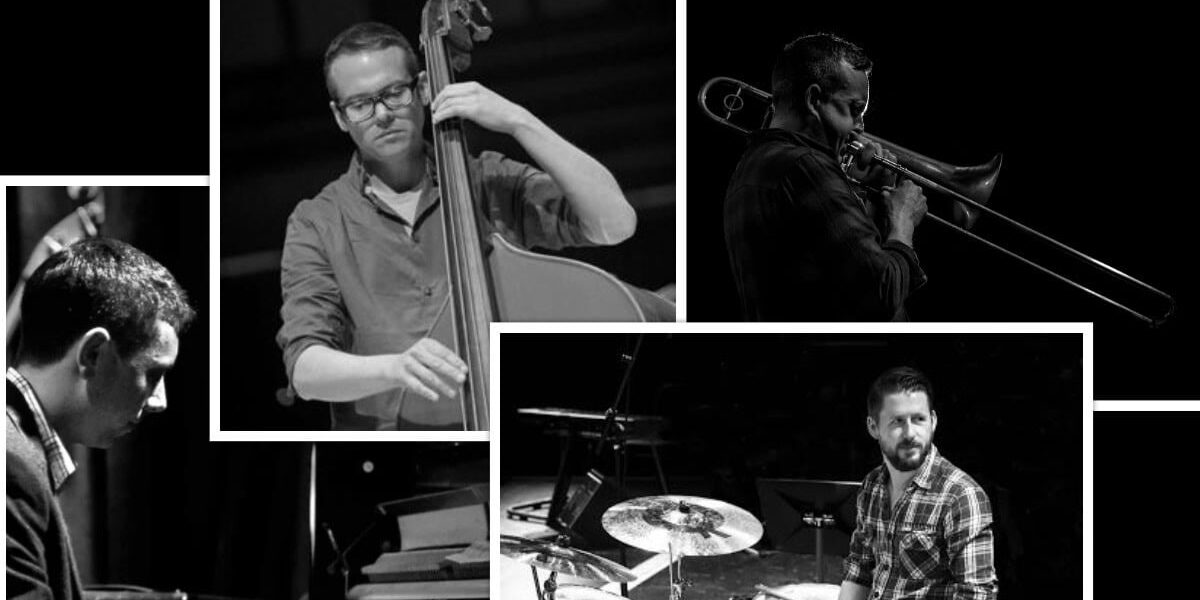
Joe O’Callaghan

Joe is mainly self-taught, although he has attended various classes over the years with Tommy Halferty and Ronan Guilfoyle. Joe has played with most leading Irish jazz musicians including Tommy Halferty, Louis Stewart, Ronan Guilfoyle, Richie Buckley, Michael Buckley and Justin Carroll.

He has also played with international musicians such as Julian Arguelles, Vincent Courtois, Dave Liebman, Tom Rainey, Martin Speake, Tanya Kalmanovitch, Paul Williamson, Nils Wogram and Dominique Pifalry. Joe is currently a member of the groups Metier, Fuzzy Logic Ensemble and Microclimate.

John Daly

John studied at Berklee College of Music Boston in 1979. He teaches and plays drums professionally in Limerick as well as touring when the need arises. He also studies vibes with Tony Miceli from Philadelphia.

John is chair of Limerick Jazz Society and a long-standing member of the society’s House Trio. The trio provides backing for leading Irish and international artists visiting Limerick. These have recently included Hugh Buckley, Michael Buckley, Myles Drennan, Linley Hamilton, Derek O’Connor, Guy Barker and Tony Miceli.

Steve Hanks

Steve is originally from Yorkshire and studied at Leeds College of Music. His main instruments are saxophone, flute and percussion.He moved to Ireland to further his interest in Irish traditional music and is based in Co. Galway. His recent jazz activities include leading the Steve Hanks Quintet which recorded for Lyric FM, and a spell as music director for the Black Magic Big Band.

Peter Hanagan

Bass player Peter Hanagan has over twenty five years experience with the ‘lowest form of music.’  He is an alumnus of the renowned UNT Jazz Studies program, and since 1999 has worked exclusively as a freelance bass guitar and double bass player, as well as a music educator.

Peter is a native of the American Southwest, but has made ….Ireland…. his home since 2001. He is a veteran of a myriad of diverse genres: East Texas blues to West African percussion music, ..Caribbean.. folk to Twentieth-century art music.

Dorota Konczewska

Dorota Konczewska is a Polish composer, jazz singer and multimedia artist living in Ireland. She comes from a background in visual arts and holds an MA in Music Technology from the University of Limerick. Her recent work includes video art, mixed media installations and cross-audiovisual genre projects. Dorota just finished recording her first jazz album with an international band in Perugia, Italy, called “Nina project” a tribute to Nina Simone. The album is expected to be presented in Ireland early next year. The ‘Nina Project’ first derived from a concert she did in Dolans last year for Limerick Jazz Society which packed the house.

Steve McFarlane

Guitar player Steve McFarlane was one of the first students to graduate from Newpark Music Centre’s jazz degree programme. He subsequently completed an H. Dip in Music Education at the University of Limerick.  He now works as music teacher at Coláiste Chiaráin, Croom, Co. Limerick. He has played professionally in Ireland in a number of musical settings ranging from jazz to popular music, and has taught at both senior and junior LJW sessions.

Category : Workshops | Blog
8
Jun

VIDEOS

Jazz education has been going for over 40 years and it works.  I’ve uploaded some very useful videos to the LJW myspace page that show the well-known jazz teacher JB Dyas of the Thelonious Monk Institute giving a seminar on Teaching Jazz Fundamentals To High School And College Musicians.  There are 10 videos which take around 90 minutes to view in their entirety and some include a supervised performance by a group of students:

1.  Jazz History
2.  Syncopation

3.  Jazz Instruments and Sounds

4.  Improvisation

5.  Rhythm
6.  Form

7.  Song Structure
8.  Tune Learning - The Definitive Version

9.  Getting Inside the Head
10.Improvising Based On the Head

I found the videos at www.artistshousemusic.org. This is a great site that also has videos of masterclasses by Kenny Werner (pianist and author of Effortless Mastery), Benny Golson (saxophone), Hank Jones (piano), Jesse McBride (piano), Larry Baione (guitar), Kirk Whalum (saxophone) and Jimmy and Percy Heath (saxophone, bass).

SOFTWARE

It can be a bit confusing working out what software can best support jazz education, so here are some personal views based on experience.

You will need a recording program or Digital Audio Workstation (DAW) and this costs nothing.  If you have a Mac you will have Garage Band for free.  If you have a PC you can download Audacity at http://audacity.sourceforge.net/.  There are obviously much sexier products for both machines but these are not really necessary for practicing.  Using either of these programs you can record yourself playing along with either a backing track from the likes of a Jamey Aebersold CD, or you can use an original version if you feel like it.  There’s nothing like hearing yourself as you really sound although it can be a bit of a shock at first!

Next up is transcribing.  The Amazing Slowdowner from http://www.ronimusic.com/ costs about $50 plus VAT and allows you to change the pitch and/or tempo of an audio file with very little loss of sound quality, and to loop particular sections.  This will make trancsribing solos as painless as is realistically possible, and transcribing is a vital tool in ear training and the development of jazz vocabulary.

Last but not least is Band In A Box from http://www.pgmusic.com/, which costs $129 for the basic version.  BIAB allows you to create your own backing tracks very easily, and to record yourself playing along with them.  If you don’t like the idea of all that inputting you can download a huge number of well known tunes in BIAB file format for free at http://phillipsmusic.net/realbook.htm.  You can change key and tempo with a mouse click.  BIAB is particularly handy for singers who need to produce charts in a key that suits them if it’s not the regular key for instrumental versions.

As well as backing tracks BIAB has some other very useful features such as ear training drills and a function that can supposedly work out the chords of a song from an audio file (only tried it once and wasn’t too impressed, but that’ll be some cheat when it eventually works!).  Just one warning - if you have a choice of BIAB for Mac or Windows the Mac version has significantly FEWER features although PG Music say this will be rectified fairly soon.

So there you are.  Really meaningful support for your jazz studies for less than euro 140!

BOOKS

This could obviously be a very long section so I’ll limit its scope to books of a general nature plus one piano book, seeing as how we’re all meant to play a bit of piano.  I can vouch for all of these from experience and they are all recommended by some of the educators I’ve studied with.  I’ve put links to Amazon below the titles so you can find out more but you might want to use Ireland’s own http://www.paulryanmusic.com/ if you buy.

Improvisation

How To Improvise and Ready, Aim, Improvise by Hal Crook.
http://www.amazon.com/How-Improvise-Hal-Crook/dp/B000M1ADP4/ref=pd_sim_b_1

Theory

The Jazz Theory Book by Mark Levine
http://www.amazon.com/Jazz-Theory-Book-Mark-Levine/dp/1883217040/ref=pd_sim_b_3

Mental Approach (this matters!)

Effortless Mastery by Kenny Werner
http://www.amazon.com/Effortless-Mastery-Liberating-Master-Musician/dp/156224003X/ref=pd_sim_b_1

Free Play by Stephen Nachmanovitch
http://www.amazon.com/Free-Play-Improvisation-Life-Art/dp/0874776317/ref=pd_sim_b_1

Piano

Jazz Piano From Scratch by Charles Beale
http://www.amazon.com/Jazz-Piano-Scratch-How-Students/dp/0634033115/ref=sr_1_10?ie=UTF8&s=books&qid=1243554220&sr=1-10
This author wanted to fill a gap in the market for beginner jazz pianists and did it.  It’s also the course book for the ABRSM jazz piano exams.

WEBSITES

http://www.jazzimprov.com/ is the website of the magazine of the same name and the article archive is really worth a look.

http://www.allaboutjazz.com/ will shortly hit 8,000 articles in its archive and is a more general jazz website.

http://www.jazzinamerica.org is designed as a resource for seconadary school education and is run by JB Dyas (see Jazz Education Videos blog).

http://www.aebersold.com is the site for the doyen of jazz play-along recordings and has a reasonable amount of free material

GRADED JAZZ EXAMS

ABRSM provides Grade 1 to 5 examinations in jazz piano and most wind and brass instruments.  They also provide ensemble examinations at beginner, intermediate and advanced levels.

London College of Music provides Grade 1 to 8 examinations in jazz piano and most wind and brass instruments.  They also provide Grade 1 to 8 examinations in electric guitar, bass and drums – these are not specifically jazz exams but cover a lot of relevant subjects such as harmony and improvisation.

LJW is happy to put interested students in contact with teachers who can prepare them for these examinations.

JAZZ DEGREES

There is full jazz performance degree course at Newpark Music Centre in Blackrock, Dublin (www.newparkmusic.com), and numerous similar courses in the UK and elsewhere.

www.jazzservices.org.uk provides a useful course search facility.

Category : Workshops | Blog
8
Jun

If you are interested, get in touch at limerickimprov@gmail.com or 086 602 5661.  At the start of each semester we have an assessment night where potential students give a quick performance and discuss their musical experience with one of the teachers.  Our students come from a wide variety of musical backgrounds (rock, classical and trad) and previous jazz experience is not required.

The ensemble-based teaching environment is not suited to teaching people the basics of their instruments and is not for complete beginners.  However please come to an assessment night whatever your level of experience as we can point you in the right direction for individual tuition.  Our teachers also provide short group courses in Jazz Theory on a regular basis, which have been useful for both current and possible future students.

If the whole idea of this kind of experience sounds a bit intimidating it can be helpful to attend a rehearsal session as a visitor.  Our ensembles use the stage, foyer and communal dressing rooms at LIT and the environment is informal and relaxed - just let us know you’d like to attend.

Participation costs €20 per session (€10 for full time students and other concessions).  Payment is by installments of €100/€50, in advance.

Category : Workshops | Blog